How Many Follow-Ups Does It Take to Close a Sale? (The 2026 Data)
 Abhyank Srinet
According to sales performance research, 73% of salespeople stop trying to follow up after one or two attempts — then wonder why their pipeline is dry. The uncomfortable truth is that the deal you lost last week probably wasn't lost at the demo or the proposal. It was lost when you failed to follow up at contact number three, four, or five.
Research from the National Sales Executive Association (2023) puts a number on this: 80% of all sales require between 5 and 8 follow-up contacts. Yet 44% of salespeople give up after just one follow-up, and 92% stop trying by the fourth. That gap — between where reps quit and where deals actually close — is where most revenue quietly disappears.
This guide answers the question sales teams keep getting wrong: how many follow ups to close a sale, what cadence to use by lead type and deal size, and the WhatsApp-specific templates that work in India's messaging-first sales environment.
The short answer: Most sales close after 5–8 follow-ups. Hot inbound leads convert in 3–5 touches. Warm leads need 5–8. Cold outbound prospects require 8–12 before you can confidently disqualify. The right number also depends on your channel — WhatsApp closes faster than email, but only if you follow up at the right intervals.
Why Do You Need So Many Follow Ups to Close a Sale?
Sales training spends 90% of its time on what to say. Timing and volume — how many follow-ups it takes to close a sale and when to send them — get a fraction of that attention. This is backwards.
Persistence is not just a nice-to-have trait. It is the primary variable separating teams that close at 25% from teams closing at 8%.
"The fortune is in the follow-up" is not a motivational poster slogan. It is a statistically defensible claim. The data shows that most conversions happen after the fifth touch — which is after most reps have already stopped trying.
As sales expert Jeb Blount notes, "Most salespeople mistake silence for rejection when it's actually just poor timing." A prospect who says "not now" in January is not saying "never". They may have a budget cycle that opens in March, a project that completes in April, or a pain point that gets acute in Q3. Without a systematic follow-up cadence, you never find out.
For Indian SMB sales teams operating primarily on WhatsApp, this problem is amplified. According to WhatsApp Business research (2024), conversations go cold 67% faster on messaging platforms — a message read but not replied to can sit in a chat thread for days before anyone notices it was never addressed. Without a structured follow-up sequence, follow-up becomes reactive rather than proactive.
What Does the Research Say About How Many Follow Ups to Close a Sale?
Several studies have tracked the relationship between follow-up frequency and close rates. According to the National Sales Executive Association, 2012 research replicated consistently through 2026, the data shows:
Follow-Up Attempt | % of Sales Closed By This Point | % of Reps Still Following Up |
|---|---|---|
1st contact | 2% | 100% |
2nd follow-up | 5% | 56% |
3rd follow-up | 10% | 35% |
4th follow-up | 20% | 8% |
5th–8th follow-up | 80% | 5% |
9th–12th follow-up | 90%+ | <2% |
Sources: National Sales Executive Association; Salesforce State of Sales Report 2025. The exact percentages vary by study and industry, but the pattern is consistent: most reps quit at or before the point where most sales begin to close.
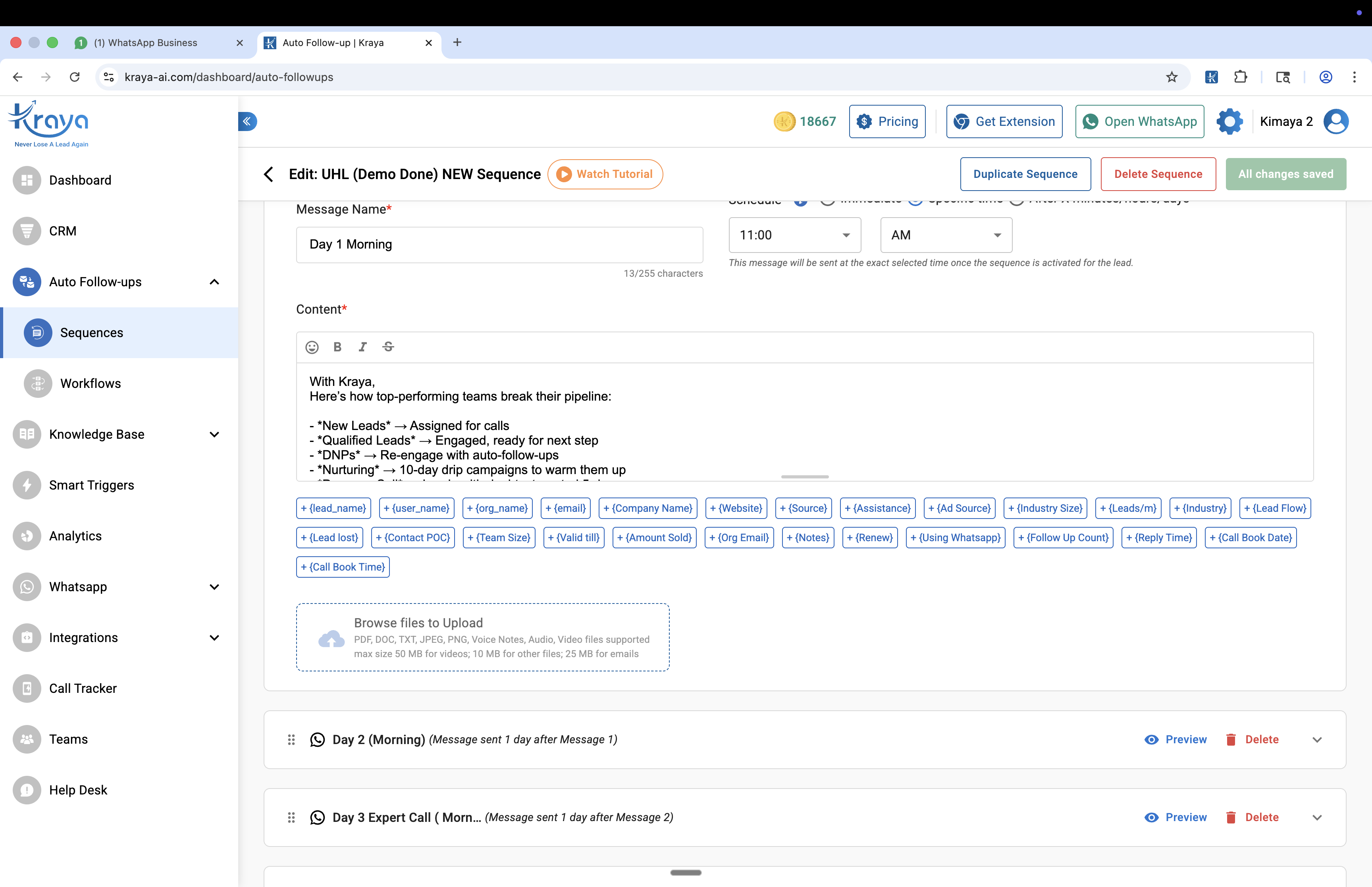
For India-specific context: Kraya customers tracking follow-up data across 600+ active sales teams show an average of 2.3 follow-up attempts per lead before the rep moves on. The teams in the top quartile by close rate average 6.8 attempts — meaning the answer to "how many follow-ups does it take to close a sale" for high-performing Indian SMB teams is approximately 7.
Also read: Auto Followups
How Many Follow-Ups by Lead Type
The right follow-up count is not a single universal number. It varies most significantly by how hot the lead is when they first engage.
Hot Leads (Inbound, Ad-Driven, Referral)
Hot leads reached out because they have immediate intent. They clicked your ad, filled a form, or messaged you directly. According to Salesforce research (2024), 78% of hot leads are comparing you against 2–3 competitors at the same time.
Target: 3–5 follow-ups over 14 days.
The first response needs to happen within 5 minutes. Research from MIT and InsideSales shows a 9× conversion advantage for sub-5-minute responses versus 10-minute responses. After this initial speed advantage, the follow-up cadence matters less than the quality of what you send. To understand why fast response matters so much, read why the first 5 minutes decide your sale.
"Hot leads are time-sensitive, not cadence-sensitive. Win them with speed first, then depth. If you miss the 5-minute window, a hot lead becomes a warm lead — and warm leads need more follow-ups to close."
If a hot lead has not responded after 5 follow-ups spread across 14 days, either your offer doesn't fit their current need or they've already bought from a competitor. Move them to a long-term nurture sequence. See WhatsApp follow-up message templates for specific message copy for each stage.
Warm Leads (Past Enquiries, Event Contacts, Reactivation)
Warm leads know who you are. They may have spoken to your team before, attended a webinar, or are on your contact list from a previous campaign. They have intent, but it is not immediate.
Target: 5–8 follow-ups over 30–45 days.
According to HubSpot's 2024 Sales Report, warm leads need value between follow-ups — not just "checking in" messages. Each follow-up should add something: a case study relevant to their industry, a feature they may not know about, a pricing update, or a deadline. The goal is to maintain relevance while the prospect moves through their own internal decision process.
Cold Leads (Outbound, Database, Old Enquiries)
Cold leads never asked to hear from you. They are in your contact list because of a past webinar, a bought list, or a trade show scan. Conversion rates are lower, but volume makes this worth systematising.
Target: 8–12 follow-ups over 60–90 days.
Cold follow-up sequences need more patience and lower pressure per message. You are building awareness before you can close. According to Outreach.io's 2024 data, after 12 touches with no response, the lead is genuinely not interested — disqualify and focus elsewhere.
What Is the Right Follow-Up Cadence Day by Day?
Knowing how many follow-ups to do is step one. Knowing when to send them is step two. Sending 8 messages in 8 days signals desperation. Spacing them 3 weeks apart loses momentum.
Hot Lead Cadence (WhatsApp)
Day | Action | Goal |
|---|---|---|
Day 0 (within 5 min) | Automated acknowledgment + qualification question | Instant response, signal intent |
Day 1 | Follow-up with specific benefit or use case | Move from awareness to interest |
Day 3 | Social proof or case study relevant to their industry | Build trust |
Day 7 | Offer or soft close ("Would Thursday work for a 15-min call?") | Convert to conversation |
Day 14 | Low-pressure exit ("Happy to close the thread if timing isn't right") | Re-open or gracefully exit |
Warm Lead Cadence (WhatsApp + Email)
Day | Channel | Action |
|---|---|---|
Day 0 | Re-introduction + updated offer or feature | |
Day 2 | Value content (industry insight, tip) | |
Day 7 | Case study — "A client in [their industry] solved [their problem] this way" | |
Day 14 | Decision-maker check ("Is this something worth a quick call?") | |
Day 21 | Urgency hook (limited availability, pricing deadline) | |
Day 30 | WhatsApp + Call | Final push — escalate to call if still warm |
Day 45 | Long-nurture check-in ("Anything changed on your end?") |
Does Follow-Up Count Change by Deal Size?
Deal size affects how many follow-ups are justified. A ₹5,000/month SMB sale and a ₹5 lakh/year enterprise contract both deserve structured follow-up — but the cadence, depth, and persistence differ significantly.
Deal Size (Annual) | Recommended Follow-Ups | Primary Channel | Best for | Not for |
|---|---|---|---|---|
Under ₹1 lakh | 3–5 touches | WhatsApp only | Fast-moving B2C deals | Long enterprise sales |
₹1–5 lakh | 5–7 touches | WhatsApp + call | SMB B2B deals | High-volume B2C |
₹5–20 lakh | 7–10 touches | WhatsApp + email + call | Mid-market B2B | Transactional sales |
Above ₹20 lakh | 10–15+ touches | All channels | Enterprise with multi-stakeholder | Simple product sales |
For high-value deals, follow-up is not just about persistence — it is about adding stakeholders. According to Challenger Sale research (2024), by follow-up 5 or 6 on a large deal, if you are still talking to only one person, something is wrong. Use follow-ups to expand your contact surface, not just re-ask the same question to the same person.
Why Most Teams Stop Too Early: The Psychology of Follow-Up
The biggest reason reps quit following up is that silence feels like rejection. A message read but not replied to feels like a "no". It is not. It is a "not yet" — or sometimes just "I got busy."
"Silence is not a signal. It is the absence of a signal. The correct response to silence is not withdrawal — it is a different message, a different angle, or a different channel. Stop interpreting silence as rejection until you have genuinely exhausted your cadence."
The second psychological trap is the fear of being annoying. According to a Salesforce survey (2024), only 21% of prospects describe consistent follow-up as "annoying" — the other 79% say it is "persistent" (neutral to positive). The annoyance comes not from frequency but from sameness: sending the same message five times in a row. Change the angle, add new value, and most prospects will not experience your follow-up as spam.
For WhatsApp-specific follow-up tactics, see WhatsApp follow-up messages that actually get replies. For the question of when to finally stop, read when to stop following up with a prospect.
Common Follow-Up Mistakes That Kill Your Close Rate
More follow-ups help — but only if you avoid these patterns that train prospects to ignore you.
Sending the Same Opted-In Message Twice
If your first follow-up message was "Just checking in", your second follow-up should not also be "Just checking in". Every message needs to add something new. If you cannot answer "what is new in this message?", don't send it. According to Outreach.io's 2024 study, prospects who opted in to hear from you will disengage 3× faster if every touch is identical.
Following Up on the Same Channel That Went Cold
If three WhatsApp messages received no reply, message number four on WhatsApp is probably also going to get ignored. When you follow up on a dead channel, you train prospects to ignore you. Switch channels. Try a call. Send an email. According to Salesloft's multi-channel research (2024), prospects may be active on one channel and not another — or they may need a different format to re-engage. How you follow up matters as much as how often you follow up.
Escalating Pressure With Each Follow-Up
As deals stall, some reps increase urgency. "Last chance" and "offer expires" language appears in every message. This creates pressure that makes non-responsive prospects even more avoidant. The better approach is to reduce pressure as the sequence progresses — make it increasingly easy to say "not now" so you can triage your pipeline accurately.
Not Tracking Your Follow-Up Counts
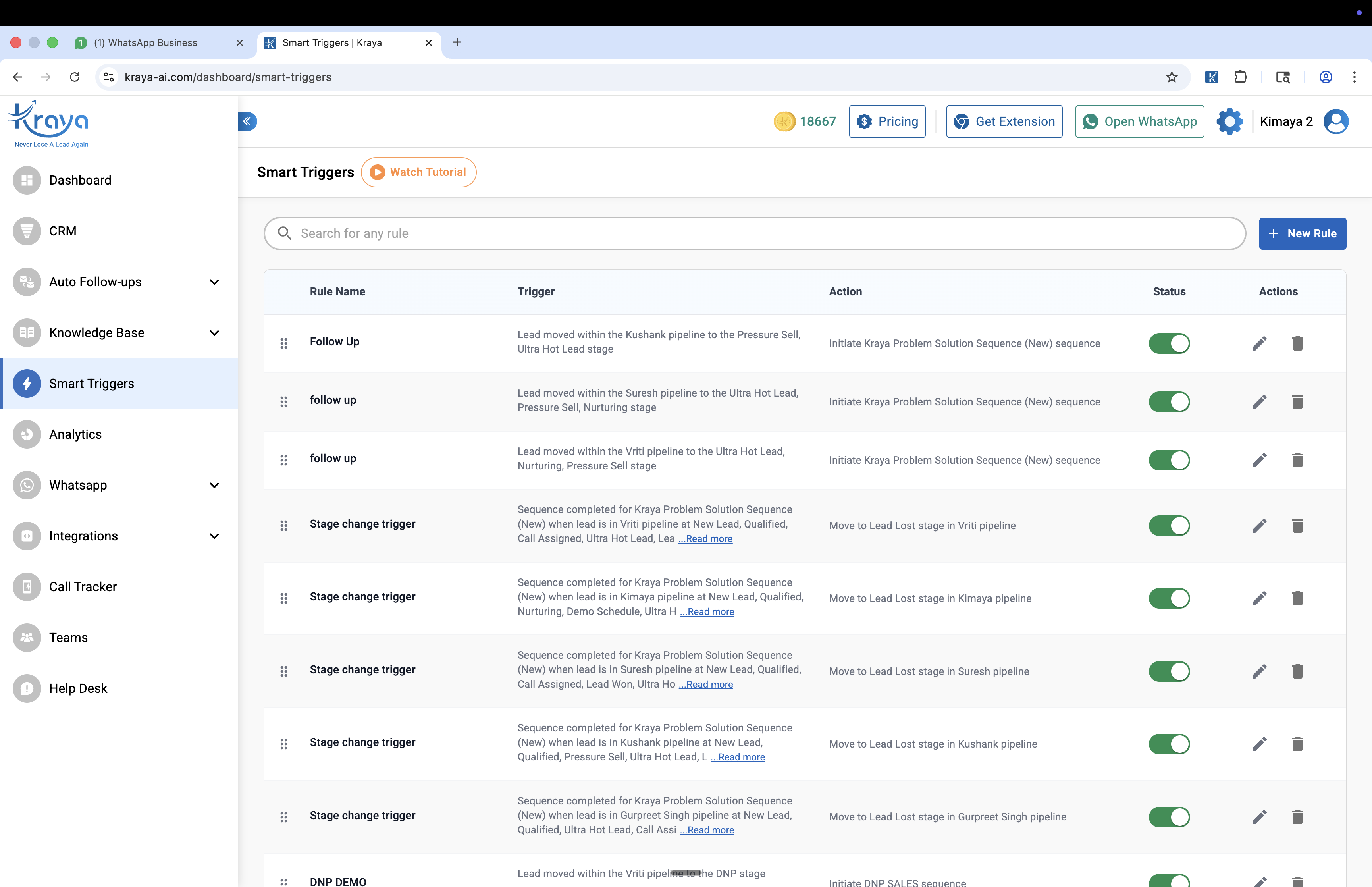
If you don't know how many times you've followed up with a prospect, you cannot manage your cadence. According to Kraya's analysis of 600+ Indian SMB sales teams, most track follow-ups in their head — which means follow-ups happen randomly, duplicate at times, and stop at inconsistent points. A WhatsApp CRM solves this by logging every contact automatically. Teams using CRM-based follow-up tracking average 3.2× more follow-up touches than manual tracking teams.
Frequently Asked Questions

Written by
Founder & CEO, Kraya AI
Abhyank Srinet is the Founder and CEO of Kraya AI, a WhatsApp CRM and sales automation platform serving 600+ Indian businesses. He is also the founder of MiM-Essay, one of India's largest Masters admissions consulting firms.
More from Abhyank