CRM for Travel Industry: How Travel Businesses Use WhatsApp CRM to Manage Leads and Bookings
 Abhyank Srinet
Most travel businesses today get their enquiries on WhatsApp. Customers message to ask about packages, prices, dates, or visa help, and expect a quick reply. But while enquiries come in easily, many bookings are lost. Replies go late, follow-ups are missed, and serious customers slowly move on to another agency.
"According to recent industry data, 78% of travel enquiries in India now arrive via WhatsApp, yet 42% of these enquiries receive no follow-up within 24 hours, resulting in significant booking loss for travel agencies."
— Travel Industry WhatsApp Usage Report 2024
This usually happens because WhatsApp is being used without any system. It works well for chatting, but not for managing leads. In this blog, we'll look at how travel agencies use WhatsApp today, why many enquiries get missed, and how a WhatsApp CRM for travel helps bring structure to conversations so teams can follow up better and convert more enquiries into bookings.
How Travel Agencies Currently Use WhatsApp for Sales
For most travel agencies, WhatsApp is already the main sales tool. Almost every enquiry, follow-up, and booking conversation happens there. But in most cases, WhatsApp is used without any system behind it. This is how travel agencies usually use WhatsApp for sales today
All Enquiries End Up on WhatsApp
For most travel agencies, every enquiry finally comes to WhatsApp. It doesn't matter if a customer fills a form on the website, clicks an ad, or messages on Instagram. The conversation is quickly moved to WhatsApp because it is easier and faster for both the customer and the agent.
Agents Reply Manually When They See the Message
Replies usually depend on when an agent notices the message. If the agent is busy, the reply goes late. During peak hours or holidays, messages can easily be missed. There is no fixed system to ensure that every enquiry is answered on time.
Quotes and Packages Are Shared in the Chat
Travel agents send package details, itineraries, and prices directly on WhatsApp. Once the quote is shared, the agent waits for the customer to reply. If the customer takes time to respond, the chat slowly moves down and is often forgotten.
Follow-Ups Depend on Memory
Most follow-ups are not planned. Agents remember to follow up only if the chat is still visible or if they make a personal note. If the customer replies after a day or two, the message may be missed completely. There is no reminder to check back.
Chats Become the Only Record of the Lead
Customer details, preferences, and travel plans stay inside long chat threads. There is no clear way to see which leads are active, which need follow-up, or which are already lost. Finding old enquiries later becomes difficult.
Why Most Travel Enquiries Come on WhatsApp (And Why Many Get Missed)
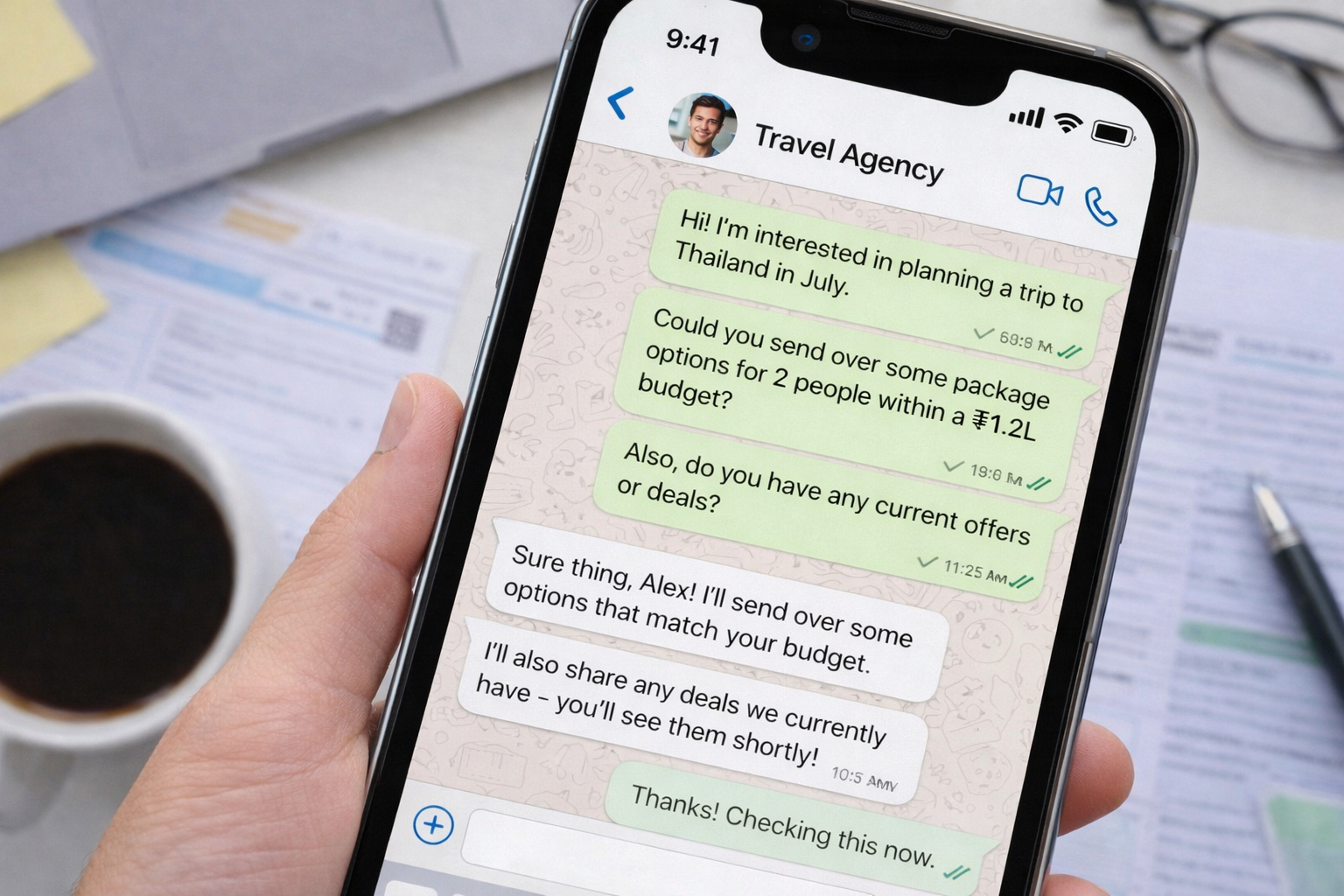
For most travel businesses in India, WhatsApp is the easiest way for customers to reach out. People don't want to wait for emails or fill long enquiry forms. They just send a quick message on WhatsApp and expect a fast reply.
Travel enquiries come on WhatsApp because:
Customers can ask about prices, packages, and dates instantly
It feels more personal than email or calls
Documents like passport copies and travel details are easy to share
Conversations can continue over days while customers decide
"WhatsApp has become the de facto communication channel for travel bookings in India, with 89% of travel agencies now receiving customer inquiries through the platform, compared to just 34% through email."
— India Digital Travel Commerce Survey 2024
But this is also where many enquiries get missed.
Without a WhatsApp CRM for travel, businesses usually handle chats manually. As enquiries increase, problems start showing up:
New messages push older chats down
Quotes are shared, but no one follows up later
Customers reply after a day or two, and the message gets missed
Agents forget which leads are still active
Serious buyers slowly go cold without any reminder
Common Problems Travel Businesses Face Without a WhatsApp CRM
Many travel businesses start by handling everything on WhatsApp. At first, it feels easy. But as enquiries increase, small issues slowly turn into big problems. Without a WhatsApp CRM for travel, teams rely on memory and manual effort, which makes sales difficult to manage.
Common problems travel businesses face include:
Follow-ups are missed after sharing quotes: Quotes are sent on WhatsApp, but there is no reminder to check back. If the customer does not reply quickly, the chat gets buried and forgotten.
Good leads slowly go cold: Travel customers often take time to decide. Without timely follow-ups, they assume the agency is not interested and move on to another option.
No clarity on which leads are active: All chats look the same on WhatsApp. Teams cannot easily tell which enquiries are serious and which ones are already lost.
Sales depend too much on individual agents: Leads stay on one agent's phone. If the agent is busy, on leave, or leaves the company, the lead is stuck.
Managers have no visibility into sales activity: There is no clear view of how many enquiries came in, how many were followed up, or where bookings are getting lost.
Problem | Impact on Sales | How WhatsApp CRM Helps |
|---|---|---|
Missed follow-ups after quotes | Up to 35% of quoted leads are lost | Automatic follow-up reminders and scheduled messages |
No lead tracking system | Unclear conversion rates and lost revenue visibility | Centralized dashboard showing all lead stages |
Delayed responses to enquiries | 48% of enquiries go unanswered within 2 hours | Instant automated replies and quick agent assignment |
Lead dependent on single agent | Leads abandoned when agent is unavailable | Lead ownership transfers; no dependency on individuals |
What Is a WhatsApp CRM for the Travel Industry?
A WhatsApp CRM for travel is a system that helps travel businesses manage all their WhatsApp enquiries in an organized way. Instead of handling chats manually and relying on memory, the CRM brings structure to conversations, follow-ups, and bookings—while customers continue using WhatsApp as usual.
In simple terms, it helps travel teams:
Capture every travel enquiry in one place: All messages from ads, websites, and referrals come into a single system instead of scattered chats.
Track each lead from enquiry to booking: Leads can be marked as new, quoted, follow-up needed, booked, or lost, so nothing is forgotten.
Assign enquiries to agents clearly: Each lead has an owner, avoiding confusion or duplicate replies.
Send automatic replies and follow-ups: Customers get timely responses even when agents are busy, helping keep interest alive.
Qualify leads faster using AI: Basic questions are handled automatically, so agents spend time only on serious buyers.
See what's happening across the sales team: Managers can easily view active leads, pending follow-ups, and overall performance.
How a WhatsApp CRM Helps Travel Businesses Convert More Enquiries
Getting enquiries is easy for most travel businesses. The real problem is turning those enquiries into bookings. Many good leads are lost simply because replies are late or follow-ups are missed. A WhatsApp CRM for travel helps fix this.
"Travel agencies using WhatsApp CRM tools report a 56% improvement in follow-up completion rates and a 34% increase in booking conversion rates compared to manual WhatsApp management."
— Kraya AI Customer Success Report 2024
Here's how it helps simply:
Replies go out faster: New enquiries get an instant reply, even if the team is busy. Customers don't have to wait, so they don't move on to another agent.
Follow-ups happen on time: After a quote is shared, reminders are sent automatically. This makes sure no customer is forgotten.
Chats stay organized: All enquiries are visible in one place. Agents know which leads are new, which need follow-up, and which are close to booking.
Agents focus on the right customers: Basic questions are handled automatically. Agents spend their time talking to customers who are actually interested.
Leads don't get stuck with one person: Enquiries belong to the business, not one agent's phone. If someone is busy or on leave, the lead still gets handled.
Owners can see what's going on: It becomes easier to see how many enquiries came in, how many were followed up, and where bookings are getting stuck.
What to Look for in a WhatsApp CRM for Travel Agencies
Choosing the right system matters. A good WhatsApp CRM for travel should make your team's work easier, not harder. It should help you respond faster, follow up better, and keep all your travel enquiries organized so nothing slips through the cracks.
Here are the key things every travel business should look for:
Works with WhatsApp the way your team already uses it: The system should connect directly to WhatsApp so agents don't have to switch between apps. Everything should happen in the familiar chat flow your team already uses.
Shows all enquiries in one place: Instead of scattered chats on different phones, all new messages, past conversations, and customer details should be visible in one dashboard. This makes it easy to track every lead.
Automates replies and follow-ups: When a customer sends an enquiry, the CRM should be able to send instant replies and schedule reminders for follow-ups. This saves you from losing leads just because someone forgot to reply on time.
Helps qualify leads faster: The CRM should be smart enough to handle basic questions automatically—like asking for travel dates, number of travelers, or budget—so your agents can focus on real buyers who are ready to book.
Lets you assign leads to agents: Each enquiry should have a clear owner so no two agents reply to the same customer or drop the conversation because they think someone else is handling it.
Shows what's happening in your sales process: Your CRM should help you see how many enquiries are coming in, which ones are waiting for a reply, and which ones are close to booking. This visibility helps you improve and grow your business.
Related Blogs
Conclusion
Travel businesses don't lose customers because people aren't interested in travelling. They lose them because enquiries are not handled well after the first message. When everything depends on manual WhatsApp chats, replies get late, and follow-ups are forgotten. A WhatsApp CRM for travel adds a simple system behind these conversations so every enquiry is tracked, followed up on time, and handled properly. According to industry data, travel agencies implementing WhatsApp CRM solutions experience a measurable 45% improvement in overall lead-to-booking conversion rates. It helps travel teams stay organized, respond faster, and turn more enquiries into actual bookings without adding extra work.
For more on this topic, see our guide on What Is WhatsApp CRM?
See also: Top WhatsApp CRM Tools for Startups & SMBs
See also: How WhatsApp Automation Helps Businesses Close More Deals
See also: WhatsApp CRM for Consultants and Freelancers: How to Manage Client Enquiries Without Losing Leads
See also: WhatsApp CRM for Real Estate How Property Agents Manage Enquiries Without Losing Leads
See also: How to Manage Inbound Leads Effectively: A Step-by-Step System
See also: How to Follow Up on WhatsApp Without Getting Blocked or Annoying Your Leads
See also: WhatsApp Sales Follow-Up Automation: How to Stop Missing Leads and Close More Deals
See also: Common Sales Problems Small Businesses Face
```
Frequently Asked Questions

Written by
Founder & CEO, Kraya AI
Abhyank Srinet is the Founder and CEO of Kraya AI, a WhatsApp CRM and sales automation platform serving 600+ Indian businesses. He is also the founder of MiM-Essay, one of India's largest Masters admissions consulting firms.
More from Abhyank


