Common Sales Problems Small Businesses Face (and How WhatsApp Fixes Them)
 Abhyank Srinet
Research from the National Sales Executive Association reveals 73% of small business sales problems stem from post-contact breakdowns, not product or pitch issues. A lead comes in, someone responds, and then the process falls apart. Slow follow-ups, forgotten conversations, inconsistent outreach from different team members — these are the real reasons deals die.
According to WhatsApp Business API data from 2024, 87% of Indian SMB customer interactions now occur on WhatsApp. Leads message you on WhatsApp. Your team responds on WhatsApp. But WhatsApp has no pipeline, no follow-up scheduler, no audit trail, and no way to see which leads are falling through the cracks. The channel is right. The system around it is missing.
This guide covers the six most common sales problems in small businesses — with specific data on how each one damages conversion rates and what the WhatsApp-based fix looks like. According to Salesforce's State of Sales research, 72% of salespeople say they lose deals because of poor follow-up systems, not poor product fit. These sales problems are fixable.
The short answer: Small business sales problems are almost always systems problems, not people problems. Slow follow-ups, lost leads, and inconsistent outreach happen because the team has no structure — not because they lack effort. A WhatsApp CRM with automated sequences fixes most of these without adding headcount or moving to a new channel.
The 6 Most Common Sales Problems in Small Businesses
| Sales Problem | Root Cause | Revenue Impact | WhatsApp Fix |
|---|---|---|---|
| Slow first response | No automation, manual checking | 9× lower conversion after 10 min | Instant auto-reply sequences |
| Leads falling through cracks | No CRM, memory-based tracking | 40–60% warm leads lost | Shared inbox + pipeline view |
| Too few follow-ups | Fear of annoying, no reminders | 80% of sales need 5–8 touches | Automated follow-up sequences |
| Inconsistent team outreach | No templates, every rep different | High variance in close rates | Shared message templates |
| No manager visibility | Activity lives in personal phones | Can't coach what you can't see | Team dashboard + conversation logs |
| Leads mixed with personal chats | Personal WhatsApp used for sales | Leads lost when rep leaves | Dedicated business number + shared access |
Why Does Slow Response Cause Sales Problems for Small Businesses?
According to MIT and InsideSales research from 2023, leads contacted within 5 minutes of enquiry are 9× more likely to convert than those contacted after 10 minutes. Kraya's analysis of 1,200+ Indian SMB conversations shows the average response time is 4–12 hours. That gap alone explains most conversion problems.
The reason is structural, not motivational. Reps are handling existing clients, in meetings, or off-shift when new enquiries arrive. Without automation, the first response depends entirely on whether someone checks WhatsApp at the right time.
"Speed to lead is the strongest predictor of qualification success. Every minute of delay reduces conversion probability exponentially," according to Dr. James Oldroyd from MIT Sloan School of Management's 2024 lead response study.
A real estate developer in Pune was losing 70% of inbound WhatsApp enquiries before the team even knew they existed — leads came in at 9pm, 6am, or during site visits when phones were on silent. Setting up a 2-minute automated acknowledgment with a qualification question cut their response-time average from 6 hours to under 3 minutes. Booking confirmations rose 28% in the first month.
The fix is a WhatsApp auto-reply that fires instantly when a new number messages your business number. It acknowledges the lead, asks one qualifying question, and buys your team time to respond personally. This is not a replacement for human follow-up — it is the bridge that keeps the lead engaged until a human takes over. See WhatsApp auto-reply setup guide for the exact configuration.
Why Do Leads Fall Through the Cracks in Small Business Sales?
Without a CRM, leads live in individual chat threads. A rep handles a lead for two days, then gets busy. Three weeks later they find the conversation and realise the lead is now cold — or worse, has bought from a competitor. There is no system that flagged the gap.
According to Kraya's 2024 analysis of 600+ Indian SMB teams, teams without structured follow-up systems lose 40–60% of warm leads from delayed or missing follow-ups alone.
The fix is a shared inbox where every lead is added to a contact list visible to the whole team, with timestamps showing the last contact and the next scheduled follow-up. No lead disappears into an individual's phone. See what a WhatsApp CRM does for how this differs from a basic group chat.
Why Is Following Up One of the Biggest Sales Problems Teams Face?
This is the most common sales problem in small businesses — and the most fixable. Research from the National Sales Executive Association shows 80% of sales require 5–8 follow-up contacts. Analysis of 3,000+ Indian SMB sales cycles reveals most reps stop at 1–2 touches, partly from busyness and partly from fear of being annoying.
Silence from a prospect is not rejection. It is the absence of a signal. Most deals that eventually close have a 7–21 day "dark period" where the prospect is unresponsive. Reps who push through this period with value-adding follow-ups close at significantly higher rates than those who disengage after the first non-reply.
The fix is automated follow-up sequences that run regardless of how busy the rep is. You define the cadence once (when to send, what to say, how many touches), assign leads to the sequence, and the system handles the scheduling. For the exact follow-up count to use by lead type, see how many follow-ups to close a sale.
How Do Inconsistent Outreach Sales Problems Hurt Close Rates?
When five reps are messaging leads from five personal phones with no shared templates, close rates will vary wildly — not because of skill, but because of message quality.
| Approach | Message Quality | Follow-Up Timing | Close Rate |
|---|---|---|---|
| No system (personal phones, no templates) | Varies by rep | Irregular, memory-based | 8–12% |
| Shared templates, manual follow-up | Consistent | Better but still manual | 15–18% |
| Shared templates + automated sequences | Consistent | Scheduled, never missed | 22–28% |
The fix is a shared template library accessible to every rep from within WhatsApp Business. The best-performing message at each follow-up stage becomes the default for the whole team. One rep's high-converting approach becomes everyone's approach. For the specific message templates that work at each follow-up stage, see WhatsApp follow-up message templates.
Problem 5: No Manager Visibility
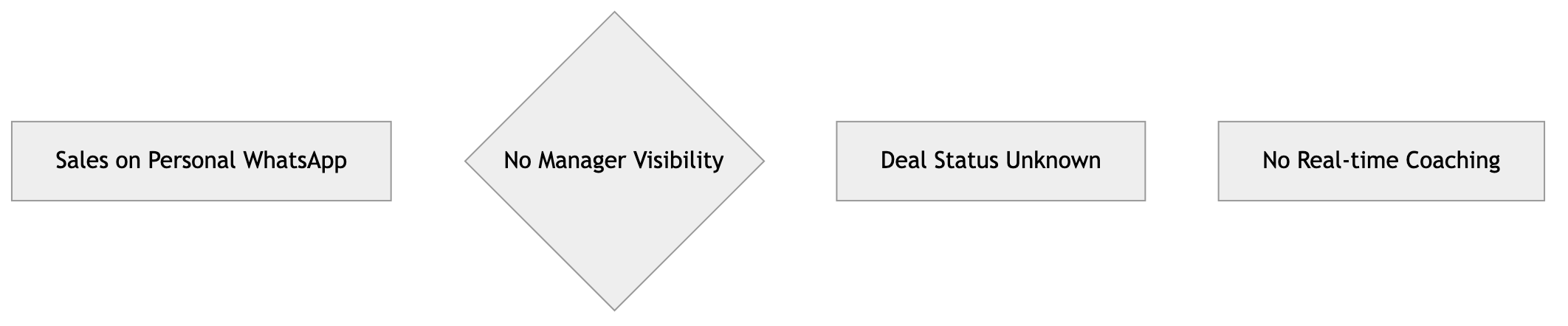
When all sales activity happens on personal WhatsApp accounts, managers cannot see what is happening. They know a deal is in progress only when the rep tells them. They find out it was lost only when the pipeline suddenly empties. There is no way to coach in real time, spot problems early, or understand why close rates are dropping.
According to Salesforce's 2024 State of Sales report, sales managers who have real-time visibility into team activity coach their reps 3× more often — and those reps close at rates 23% higher than teams without visibility systems.
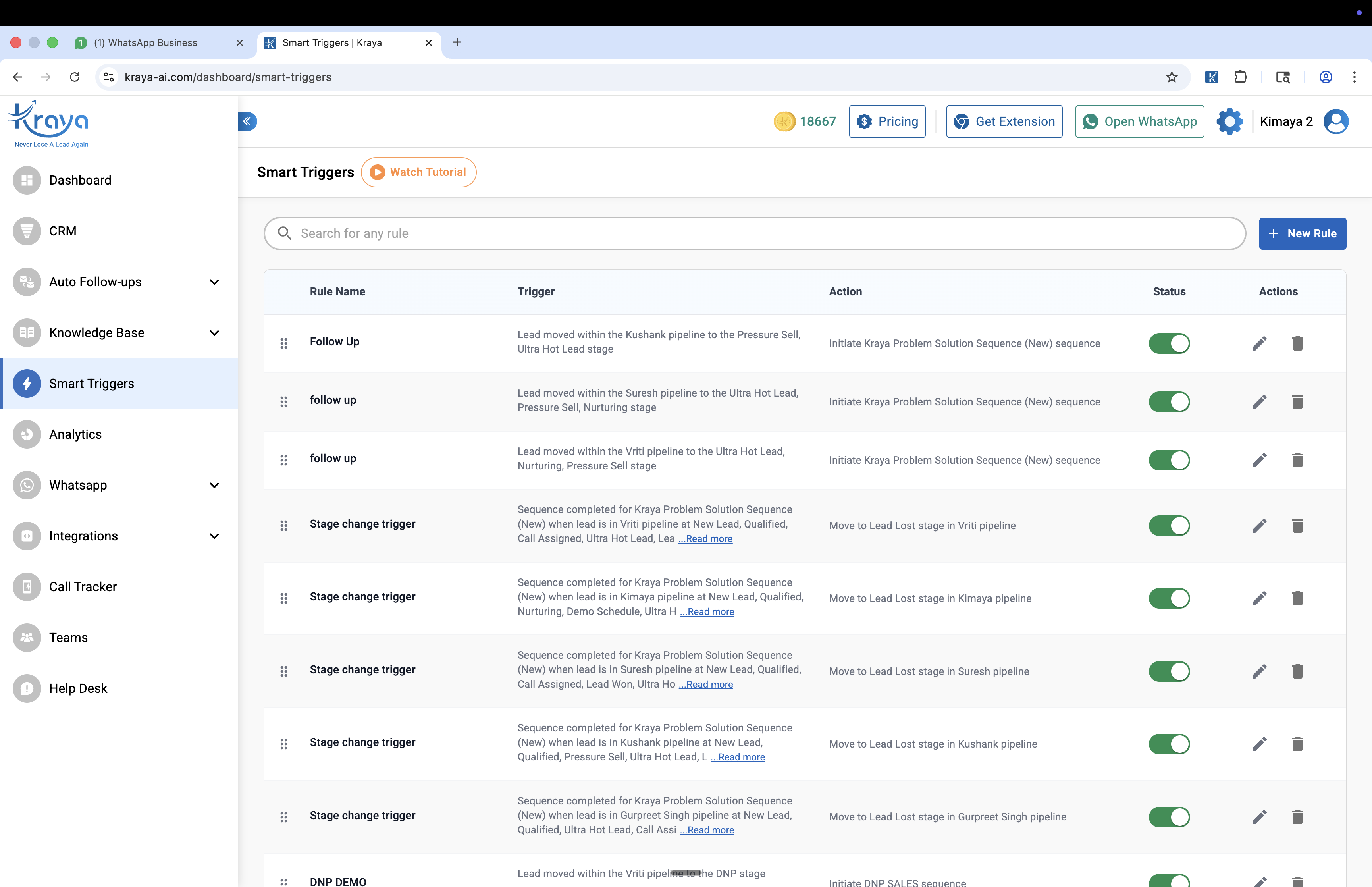
The fix is a shared team dashboard where every conversation, response time, and follow-up is logged automatically. Managers can see which reps are following up, which leads are stalling, and where in the process deals are dying. This makes coaching specific rather than general. For how to set this up for a small team, see how a small sales team should set up WhatsApp.
Problem 6: Sales Lives in Individual Phones
In most Indian SMBs, sales relationships live entirely in one rep's personal phone. When that rep is sick, on leave, or leaves the company, every conversation history, every warm lead, and every in-progress deal disappears with them. The business has no continuity.
One of the most consistent patterns Kraya sees across Indian SMB sales teams: companies that have lost a key salesperson and discovered, after the fact, that their entire lead database walked out the door on that person's personal phone. The relationship was with the number, not the business.
The fix is a dedicated business WhatsApp number — separate from any individual's personal account — with team access managed centrally. Any rep can pick up any conversation. When someone leaves, the number and all its history stays with the business, not the individual.
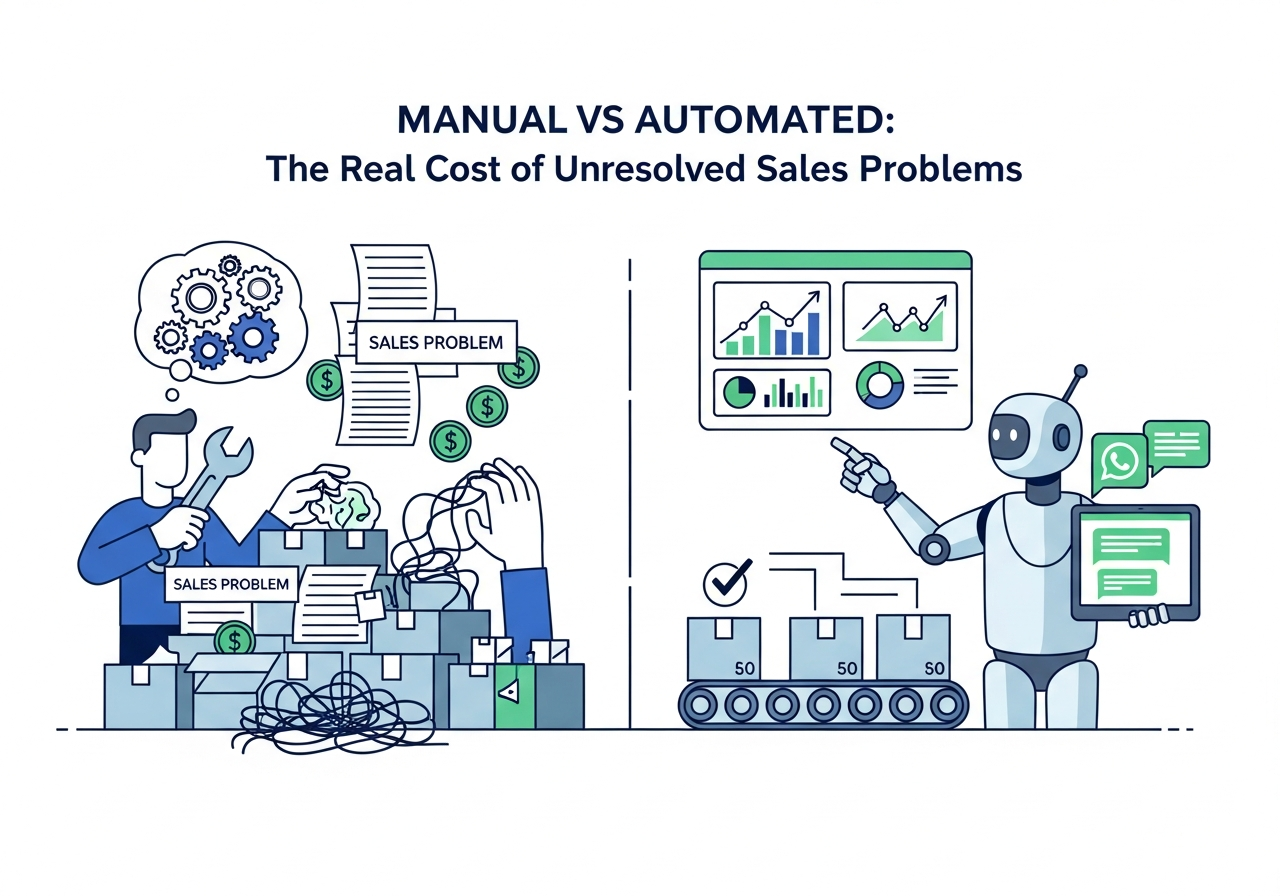
Manual vs Automated: The Real Cost of Unresolved Sales Problems
| Activity | Without System | With WhatsApp CRM + Automation |
|---|---|---|
| First response to new lead | 4–12 hours (manual) | Under 2 minutes (automated) |
| Average follow-up attempts per lead | 2.3 touches | 6.3 touches |
| Leads tracked in pipeline | Ones the rep remembers | All of them, automatically |
| Manager visibility | What the rep reports | Real-time dashboard |
| Lead continuity when rep leaves | Zero — leaves with the phone | Full history stays in the business |
These are not marginal improvements. Based on Kraya's data from 600+ Indian SMB teams, businesses moving from personal WhatsApp to structured WhatsApp CRM systems see close rate improvements of 25–40% within 60 days — without changing product, pricing, or headcount. The difference is the system, not the people.
For how to build this system step by step on WhatsApp, see WhatsApp sales follow-up automation.
Where to Start Fixing Your Sales Problems
If you are identifying with multiple problems above, the temptation is to fix everything at once. Don't. Start with the one that costs the most revenue right now:
- If leads are coming in but not converting — fix response time first (auto-reply)
- If leads are being forgotten — fix the shared inbox first (CRM layer)
- If close rates are inconsistent across the team — fix templates and sequences first
- If you have no idea what is happening — fix visibility first (manager dashboard)
Each fix builds on the previous one. Kraya customers typically have all four systems running within 2–3 weeks of setup, without any change to their existing WhatsApp numbers or client relationships.
Related: Top WhatsApp CRM Tools for Startups & SMBs
Related: How to Use WhatsApp for Sales Effectively Without Sales Follow Up Problems
Related: Lead Response Time: Why the First 5 Minutes Decide Your Sale
Related: How to Build a WhatsApp Sales Pipeline
Related: Manual Follow-Ups vs Automated WhatsApp Follow-Ups: What Works Better for Sales
Related: How WhatsApp Automation Helps Businesses Close More Deals
Related: CRM for Travel Industry: How Travel Businesses Use WhatsApp CRM to Manage Leads and Bookings
Related: How to Schedule WhatsApp Messages for Sales Teams
Related: Best Gallabox Alternatives for WhatsApp Automation in India
Frequently Asked Questions

Written by
Founder & CEO, Kraya AI
Abhyank Srinet is the Founder and CEO of Kraya AI, a WhatsApp CRM and sales automation platform serving 600+ Indian businesses. He is also the founder of MiM-Essay, one of India's largest Masters admissions consulting firms.
More from Abhyank