WhatsApp Cold Outreach in 2026: What Still Works, What Changed, and How to Do It Without Getting Banned
 Abhyank Srinet
Why Do Indian Businesses Struggle With WhatsApp Cold Outreach — and What Actually Works?
A coaching institute in Noida buys a 10,000-contact lead list for ₹5,000, loads it into a WhatsApp bulk tool, and fires off messages over a weekend. 200 replies come in. Sounds decent — until you do the math: that's 2%. Meanwhile, half those contacts blocked the number. WhatsApp flags the account quality rating as "Low." Three weeks later, the number is permanently banned.
This plays out across Indian businesses every week. The problem isn't WhatsApp cold outreach itself — it's that most businesses do it with the wrong tools, unverified lists, and no understanding of what Meta actually penalises. In 2026, with India's DPDP Act now in force and Meta tightening enforcement, the gap between doing this right and doing it wrong has never been wider.
Here's what works, what's changed, and how to run WhatsApp cold outreach in India without losing your account or breaking the law.
The short answer: WhatsApp cold outreach — messaging contacts who haven't previously interacted with your business — still works in 2026, but delivers around 2% reply rates versus 20% for warm outreach. Done through the official API with compliant templates and DPDP consent in mind, it's legal and scalable. Done with unofficial bulk tools or unverified purchased lists, you'll get banned and risk significant fines.
- Use the official WhatsApp Business API — not third-party bulk senders or browser automation tools
- Keep your block rate below 2% (Meta's account quality threshold)
- Warm up new numbers over 7–14 days before scaling to high volumes
- India's DPDP Act 2023 requires documented consent for every number you contact
- For cold outreach at scale: Kraya API (₹3,000/month). For warm follow-up on replies: Kraya Chrome extension.

What Exactly Is WhatsApp Cold Outreach?
WhatsApp cold outreach is the practice of sending WhatsApp messages to contacts who have no prior relationship with your business. In practice, this usually means one thing: a business buys a lead list — phone numbers of people who fit a certain profile (students looking for MBA coaching, homebuyers in a specific city, business owners in a target sector) — and messages them unsolicited, hoping to find interested prospects among the noise.
This is fundamentally different from warm outreach, where you're messaging people who've already shown intent — clicked a Click-to-WhatsApp ad, filled a form on your website, or sent you a message first. Warm outreach on WhatsApp gets around 20% reply rates. Cold outreach gets around 2%. That 10x gap isn't about message quality — it's entirely about context and consent. Warm prospects know who you are and why you're reaching out. Cold prospects don't.
It's also not the same as broadcast marketing (sending to opted-in subscribers via the API) or using WhatsApp for customer support. Cold outreach is specifically about first contact with people who've never engaged with your business — which is what makes both the opportunity and the risk unique.
WhatsApp cold outreach to purchased lead lists delivers approximately 2% reply rates — compared to 20% for warm outreach to contacts who've previously engaged with your business.
Why WhatsApp Cold Outreach Still Matters in 2026
Despite a 2% reply rate, WhatsApp cold outreach remains attractive to Indian SMBs for one reason: the channel is where their customers actually spend time. Email open rates in India average 15–20%. WhatsApp open rates exceed 90%. Even at 2% reply rates, a well-executed campaign to a 5,000-contact list generates 100 conversations — more than most email campaigns produce at the same list size. The question for 2026 isn't whether to use it. It's how to do it without getting banned or fined.
How Does WhatsApp Cold Outreach Actually Work?
The mechanics are straightforward. What trips up most Indian businesses is the compliance layer — specifically, which tools are allowed to send at volume, and what message structure the official API requires for first contact with new numbers.
Through the WhatsApp Business API (the only compliant channel for scale), every first message to a new contact must use a Meta-approved message template. You can't send a freeform "Hi, I noticed you're looking for MBA coaching" — it must match an approved template format that you've submitted in advance. Once the recipient replies, the conversation opens up to freeform messaging, which is where the actual sales conversation happens.
| Step | Action | Time Required | Notes |
|---|---|---|---|
| 1 | Source a contact list with consent documentation | 1–3 days | DPDP compliance requires verified consent records per number |
| 2 | Set up WhatsApp Business API access | 2–3 days | Kraya handles end-to-end API setup and number verification |
| 3 | Create and submit message templates for Meta approval | 1–2 days | Templates are reviewed before you can send to new contacts |
| 4 | Warm up the number in week one | 7 days | Start at 100–200 new conversations/day; scale gradually |
| 5 | Send in batches and monitor quality rating | Ongoing | Pause immediately if quality rating drops to "Low" |
| 6 | Manage replies and move prospects to pipeline | Real-time | Use Kraya CRM to track conversations and schedule follow-ups |
What Are the Different Approaches to WhatsApp Cold Outreach?
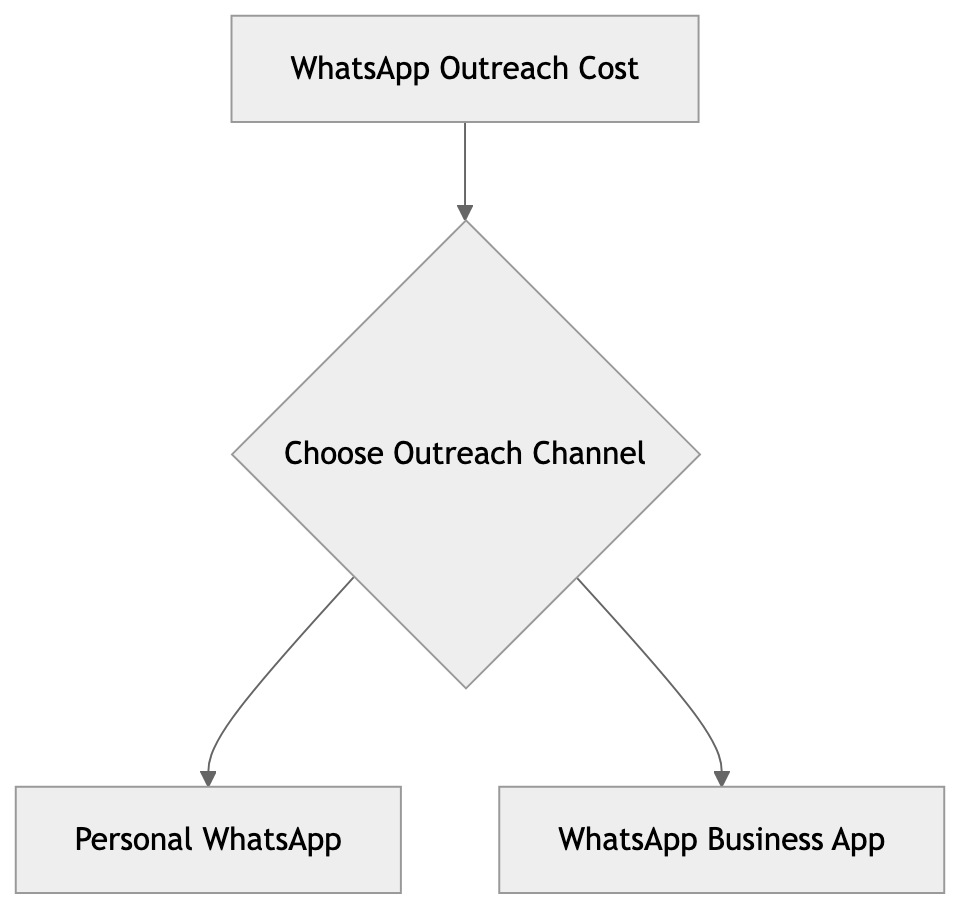
Not all WhatsApp channels carry the same risk. The biggest mistake Indian businesses make is assuming that because they're on WhatsApp, the ban risk is uniform across all sending methods. It isn't — Meta treats personal WhatsApp, WhatsApp Business App, unofficial bulk tools, and the official API entirely differently, and enforcement has tightened significantly since 2025.
Here's how the four main approaches compare on the dimensions that matter for an Indian sales team:
| Approach | Volume Ceiling | Ban Risk | Cost | Best For |
|---|---|---|---|---|
| Personal WhatsApp | ~100/day | Very High — number ban within days at any real volume | ₹0 | Never for business cold outreach |
| WhatsApp Business App | ~256 contacts per broadcast | High — restrictions and bans common above this threshold | ₹0 | Small-scale testing only |
| Unofficial bulk tools | Unlimited (until banned) | Critical — see automation ban risk guide | ₹500–₹2,000/month | Never — violates Meta Terms of Service |
| Official API (e.g. Kraya) | Unlimited with approved templates | Very Low (behaviour-dependent, not tool-dependent) | ₹3,000/month full suite | WhatsApp cold outreach at scale |
Meta doesn't ban accounts for doing WhatsApp cold outreach — it bans accounts for spammy behaviour: high block rates, unofficial automation tools, and sending freeform messages to new contacts without approved templates.
What Are the Rules for Safe WhatsApp Cold Outreach?
Meta's enforcement model in 2026 is entirely behaviour-based. Your account isn't flagged because you're doing cold outreach — it's flagged because recipients are blocking you, you're using tools that simulate browser automation, or your quality rating has dropped below Meta's threshold. Understanding these rules makes cold outreach manageable at any volume.
These four rules are non-negotiable. Violate any one consistently and you'll lose the number — which in practice means rebuilding your entire cold outreach infrastructure: new number, new warm-up period, lost conversation history, broken pipeline.
Rule 1: Use the Official API for Any Volume Above 250 Messages Per Day
The WhatsApp Business App caps broadcast lists at 256 contacts, requires all recipients to have your number saved, and has no batch management or analytics. For any serious cold outreach operation, the Business API is the only viable option. It supports unlimited volume (subject to quality rating), requires pre-approved templates for new contact outreach, and doesn't trigger the automation detection patterns that unofficial bulk tools consistently set off.
Rule 2: Keep Your Block Rate Below 2%
Meta monitors the ratio of recipients who block your number after receiving your message. Above 2%, your account quality rating drops to "Low" — which progressively restricts how many new conversations you can initiate per day. Above roughly 5%, you're looking at a temporary suspension. Above 10%, permanent ban. This is why message quality matters more than raw volume: a personalised opening message to 500 contacts is consistently safer than a generic blast to 5,000.
Rule 3: Warm Up New Numbers Over 7–14 Days
New WhatsApp Business API numbers start with messaging caps that increase as Meta builds trust in the account. In week one, stay at 250 new conversations per day. Week two, scale to 1,000. From week three onward, you can push to 10,000+. Jumping straight to high volume from a fresh number is one of the fastest routes to a permanent ban — Meta's systems flag the sudden activity spike as suspicious regardless of message quality.
Rule 4: Always Include a Clear Opt-Out in Your Template
Every cold outreach template should give the recipient a clear way to stop messages — "Reply STOP to opt out" is the standard phrasing. Recipients who can opt out don't block you; recipients with no exit option do. This single change consistently reduces block rates by 30–50% across campaigns. With India's DPDP Act now in force, including an opt-out mechanism is also increasingly a legal requirement, not just a best practice.
How Does Indian Law Affect WhatsApp Cold Outreach?
India's Digital Personal Data Protection (DPDP) Act 2023 is the most significant legal development affecting WhatsApp cold outreach for Indian businesses. The Act requires that personal data — including phone numbers — can only be collected and processed with the explicit, informed consent of the individual. Buying a lead list of 10,000 numbers and messaging them constitutes processing personal data. If the vendor can't prove each contact opted in to receive third-party business communications, you're operating without lawful consent.
Enforcement is still maturing — the Data Protection Board of India is being constituted and penalties haven't been widely levied against SMBs yet. But the legal exposure is real: DPDP penalties reach up to ₹250 crore for serious violations, and the compliance bar will only rise. More immediately, Meta's own WhatsApp Business Policy independently requires that businesses only initiate conversations with users who have requested or opted into communications — creating a dual compliance requirement even before DPDP enforcement ramps up.
The practical implication for Indian businesses doing WhatsApp cold outreach in 2026: if you're buying lists, demand consent documentation for every number before you use them. If the vendor can't produce it, don't use the list. The safest route for generating compliant cold outreach contacts is Click-to-WhatsApp (CTWA) ads — where users initiate the conversation themselves, building consent into the first interaction and eliminating both the Meta policy risk and the DPDP exposure.
Under India's DPDP Act 2023, messaging phone numbers from a purchased lead list without documented opt-in consent constitutes unlawful data processing — regardless of which WhatsApp channel you use to send the messages.
What Does WhatsApp Cold Outreach Actually Cost?
The true cost in India depends on which channel you use and whether you factor in the risk cost of a ban. A banned number doesn't mean downtime for a day — it means losing the number permanently, including all chat history and pipeline conversations. For a sales team that's been building WhatsApp relationships for months, that's a significant operational loss on top of the direct rebuild cost.
| Path | Direct Monthly Cost | Ban Risk Cost | Realistic Effective Cost |
|---|---|---|---|
| Personal WhatsApp + manual sending | ₹0 | Number ban within 2–4 weeks at business volume | Not viable — not a cost question |
| WhatsApp Business App | ₹0 | Account restrictions above 256/day; ban likely at scale | Low volume only — not scalable for cold outreach |
| Unofficial bulk tools | ₹500–₹2,000/month | Number ban within 1–3 months; cycle of new numbers + setup time | ₹6,000–₹24,000/year in tool fees + constant rebuild costs |
| Kraya API full suite | ₹3,000/month | Very Low — official Meta-approved channel | ₹3,000/month + ~₹0.58–0.79 per conversation (Meta fees) |
The per-conversation cost on the official API looks higher upfront. But businesses that have cycled through unofficial tools — buying new SIM cards every few months, re-warming numbers, rebuilding contact lists after bans — consistently find the API cheaper over a 12-month horizon. The unofficial tool path is a treadmill; the API is a stable foundation.
When Should You Use Kraya for WhatsApp Cold Outreach?
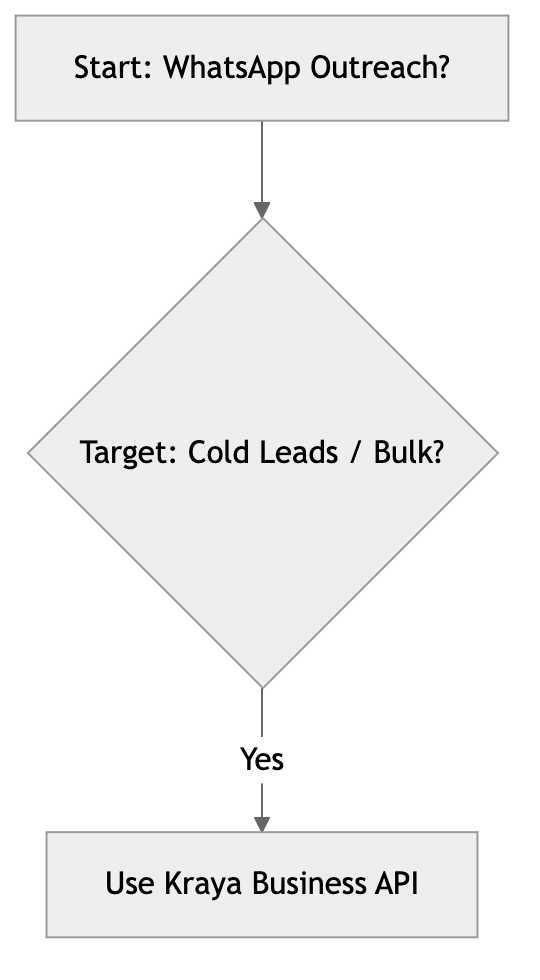
Kraya has two distinct products, and they solve different parts of the WhatsApp cold outreach problem. Using the wrong one costs either money or reply rates — and most businesses need both working together to close the gap between a 2% cold reply rate and a 20% warm conversion rate.
Kraya's Two Products for WhatsApp Outreach
| Product | Use Case | Ban Risk | Setup Time |
|---|---|---|---|
| Kraya Business API | WhatsApp cold outreach to lead lists, bulk campaigns, outbound to large opted-in contact bases | Very Low — official Meta-approved channel | 2–3 days (Kraya handles end-to-end) |
| Kraya Chrome Extension | Warm lead management — following up with cold outreach replies, managing CTWA ad conversations, personalised follow-ups on existing contacts | None — no bulk sending involved | Instant — installs in browser, works on WhatsApp Web |
From our work with 600+ Indian businesses, the teams getting the best results from WhatsApp outreach combine both. They use the API for initial cold outreach — generating that first 2% of interested replies from a large list. Then they move those interested contacts into the Chrome extension pipeline for warm, personalised follow-up — where reply rates jump to 20%. The cold outreach surfaces the lead; the warm follow-up closes it. Running cold outreach without a warm follow-up system means you're doing the hardest, most expensive part of WhatsApp sales and then dropping the ball at the moment of highest intent.
The most effective WhatsApp outreach strategy for Indian sales teams in 2026 isn't cold or warm — it's using the API to find interested prospects at 2%, then switching to personalised warm follow-up to convert them at 20%.
What Are the Most Common WhatsApp Cold Outreach Mistakes to Avoid?
Mistake 1: Buying Lead Lists Without Verifying Consent Documentation
Most lead list vendors in India cannot produce evidence that each contact explicitly opted in to receive WhatsApp messages from third-party businesses. Without that documentation, you're exposed under both Meta's Business Policy and India's DPDP Act 2023. Always ask for consent records before purchasing any list — if the vendor can't produce them, the list isn't usable for compliant WhatsApp cold outreach.
Mistake 2: Using Unofficial Bulk Tools to Send at Volume
WhatsApp's spam detection in 2026 identifies automation patterns — message timing regularity, browser fingerprinting from WhatsApp Web automation, message velocity spikes — that unofficial bulk tools all generate. The official API sends via Meta's own infrastructure and doesn't trigger these signals. Unofficial tools save you ₹1,000–₹2,000/month on the tool fee and cost you the number.
Mistake 3: Sending One Generic Template to Everyone
A generic "Hi, I'd like to tell you about our services" opening message gets blocked by 10–15% of cold WhatsApp recipients. Personalising the first message — with the recipient's name, their city, or a reference to what their business does — consistently reduces block rates below 2% on the same list. For the complete breakdown of what goes wrong with WhatsApp cold outreach and how to fix each issue, read our detailed guide: 7 WhatsApp cold outreach mistakes that kill your reply rate.
How Do You Recover If WhatsApp Cold Outreach Goes Wrong?
If your number has been flagged or banned, the first step is understanding whether it's temporary (quality rating restriction) or permanent (account ban). Quality rating restrictions lift when your block rate improves — reduce volume, improve message personalisation, and give it 7–14 days. Permanent bans require a new number and a full warm-up cycle starting from day one.
To avoid needing recovery in the first place, the single most effective change for these campaigns is moving from unofficial tools to the official API before your first number gets banned — not after. The warm-up and template approval process takes a week; the cost of a ban takes months to recover from.
Related reading: WhatsApp ban prevention guide, temporary vs permanent ban: what's the difference, which automation tools get you banned, how to send bulk WhatsApp messages without getting banned.
For businesses that want managed WhatsApp cold outreach without the compliance and operational risk, talk to the Kraya team about the right setup for your use case — API for cold outreach at scale, Chrome extension for warm lead follow-up.
Related: 12 WhatsApp Cold Outreach Templates That Actually Get Replies