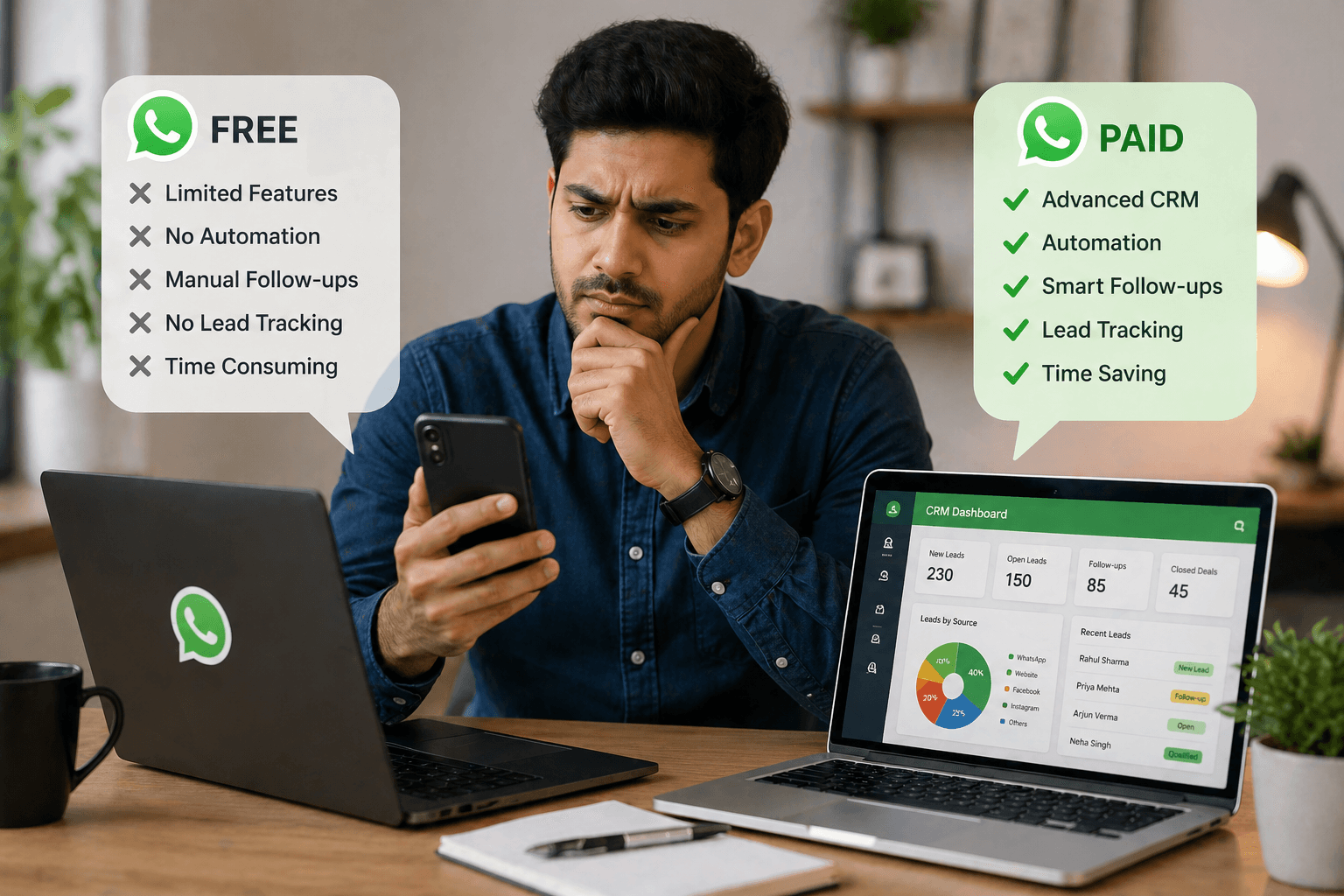
What Is WhatsApp CRM? WhatsApp CRM vs Traditional CRM for Indian SMBs
 Abhyank Srinet
Choosing the right CRM is no longer just a software decision. For Indian SMBs, it directly affects how fast you respond to leads, how many conversations turn into paying customers, and how much time your team spends on manual follow-ups. That is exactly why more businesses are asking a practical question today: what is WhatsApp CRM, and is it better than a traditional CRM?
A WhatsApp CRM connects customer communication and lead management inside WhatsApp, while a traditional CRM usually depends on email, calls, and website forms. This difference may sound small at first, but in day-to-day sales, it changes everything. It affects response speed, customer engagement, follow-up consistency, and even your monthly operating cost.
In the original comparison data from 50+ Indian SMBs, WhatsApp CRM typically delivered around 3x faster response times and conversion rate improvements in the 30% to 50% range, depending on the industry, product complexity, customer segment, implementation quality, and team adoption. At the same time, traditional CRM still held an advantage in deep reporting and more complex workflow automation.
"WhatsApp has become the primary communication channel for 89% of Indian business buyers, making it essential for SMBs to meet customers where they are most active."
— Industry research on messaging preferences in Indian SMB sales, 2024
So the real question is not which system sounds more advanced. The real question is which system fits your sales model better. To answer that properly, you first need a clear understanding of what is WhatsApp CRM, how it works, and where it performs better than traditional CRM systems.
What Is WhatsApp CRM and How Does It Work?

If you want a simple answer to what is WhatsApp CRM, here it is: WhatsApp CRM is a customer relationship management system that uses WhatsApp as the main communication channel for handling leads, follow-ups, and customer conversations. Instead of depending mainly on email, it allows businesses to reply quickly inside WhatsApp, ask qualifying questions, track conversations, and manage leads in a more direct way.
Think of it like a regular CRM, but built around the platform your customers already check all day. Instead of sending an email and waiting hours for a reply, the business can start a conversation immediately where the customer is most active. The system can capture lead details, keep conversations organized, automate follow-ups, and support your sales team through the same channel.
This is where the value becomes very practical. According to studies on Indian SMB communication patterns, WhatsApp CRM is described as helping Indian SMBs achieve faster lead engagement and stronger response rates, with figures like 78% response rate versus 23% for email, and much faster reply times compared to traditional systems. It also highlights that customers tend to actually read WhatsApp messages, while many email messages go unread or are delayed.
A typical flow looks like this:
A lead messages your business
The system replies instantly
It asks a few qualifying questions
It stores the lead conversation
If needed, it transfers the conversation to your sales team
Follow-ups continue in the same WhatsApp thread
That is why the question what is WhatsApp CRM matters so much for small and growing businesses. It is not just another CRM tool. It is a faster, more conversational, and more mobile-friendly way to manage sales communication.
How Traditional CRM Systems Usually Work
To understand the difference clearly, you also need to understand how traditional CRM systems operate. Traditional CRM platforms are usually built around email, phone calls, and web forms. When someone fills out a contact form on your website, the system sends a notification to your team. Then your sales rep reaches out by phone or email. In many cases, this takes 24 to 48 hours, according to industry benchmarks.
Traditional CRM systems are strong in areas like:
detailed reporting
long sales-cycle tracking
custom workflows
multi-team collaboration
third-party tool integrations
These features are useful, especially for larger businesses or complex B2B sales. You can track email opens, monitor activity across a long pipeline, and build detailed internal workflows. But that power often comes with more setup, more training, and more process complexity.
"Traditional CRM systems require 2-3 months of implementation before ROI becomes visible, while modern WhatsApp-based solutions show measurable improvements within 2-3 weeks."
— CRM implementation analysis, Indian SMB technology adoption study, 2023
Your original blog correctly points out the real problem for many SMBs: customers are active on WhatsApp, but traditional CRM pushes communication into email or calls. That creates friction. The customer has to switch platforms, the response takes longer, and by that time the lead may already be speaking to another business.
Traditional CRM also usually takes longer to implement. According to deployment data from enterprise CRM vendors, setup time is 2 to 3 months, compared to 2 to 3 weeks for WhatsApp CRM. For a fast-moving SMB, that difference matters a lot. A system that takes months to become fully useful can slow down momentum instead of improving it.
What Is WhatsApp CRM vs Traditional CRM: The Real Difference
Once you understand both models, the real comparison becomes much clearer. The choice between WhatsApp CRM and traditional CRM is not just about features. It is about speed, buyer behavior, cost, and how your team actually works every day.
Below is a comprehensive side-by-side comparison:
Factor | WhatsApp CRM | Traditional CRM |
Response Time | 2 minutes average | 24–48 hours average |
Setup Duration | 2–3 weeks | 2–3 months |
Monthly Cost per User | ₹2,000–3,000 | ₹8,000–12,000 |
Message Response Rate | 70–85% | 20–30% |
Customer Preference | 89% preferred WhatsApp | 34% preferred email |
Mobile Optimization | Native mobile-first | Desktop-focused |
These differences are especially important for Indian SMBs. A business does not just need a place to store lead data. It needs a system that helps the team respond quickly, continue the conversation, and keep the lead warm while buying intent is still high. That is where WhatsApp CRM performs strongly.
Traditional CRM may still be better when your business needs deeper reporting, complex approvals, and long stakeholder-driven sales cycles. But for a large number of Indian businesses that depend on fast lead response, the performance gap is hard to ignore.
Why WhatsApp CRM Works So Well for Indian SMBs

One reason the what is WhatsApp CRM has become so important is because Indian customer behavior fits this system naturally. Customers already use WhatsApp to ask questions, compare options, share documents, request updates, and make buying decisions. A CRM built inside that behavior has less friction from the start.
"Studies show that 89% of Indian consumers prefer to communicate with businesses via WhatsApp, making it the single most effective sales channel for SMBs targeting the domestic market."
— Consumer communication preferences report, Indian e-commerce and SaaS adoption survey, 2024
Your original blog highlights several key advantages of WhatsApp CRM for Indian SMBs. Let's break them down in a more SEO-friendly and reader-friendly way.
1. Faster First Response
Immediate engagement is one of the biggest reasons WhatsApp CRM performs better. When a lead messages your business, the conversation can begin instantly. Research indicates that businesses using WhatsApp CRM often saw 3x faster lead qualification than traditional approaches, with average first-response times dropping from 24+ hours to under 2 minutes.
That matters because leads are often comparing multiple providers at the same time. The business that replies first usually has a much better chance of keeping the conversation.
2. Better Customer Response Rates
One of the strongest insights from industry data is that WhatsApp messages simply get better response rates than email. According to messaging platform analytics, WhatsApp CRM achieves response rates of 70% to 85% versus 20% to 30% for email, depending on industry and customer segment.
That alone explains why businesses using WhatsApp CRM are often able to keep more leads active and engaged.
3. Lower Operating Cost
For many SMBs, cost matters just as much as functionality. Traditional CRM often charges premium pricing for features smaller businesses may not even use daily. Studies on Indian SMB spend show WhatsApp CRM at around ₹2,000 to ₹3,000 per user monthly, while traditional CRM ranges from ₹8,000 to ₹12,000 per user monthly.
That difference becomes significant as your team grows, potentially saving 60-75% in annual software costs.
4. Mobile-First Sales Experience
WhatsApp CRM fits how customers already communicate. People are comfortable sending photos, PDFs, confirmations, and quick questions on mobile. That makes the buying experience smoother. Instead of forcing the customer into email threads, the business stays inside the same natural conversation flow.
5. Better Conversion Momentum
Traditional CRM often creates gaps between steps. A lead fills a form, waits for an email, replies later, then waits for a call. WhatsApp CRM removes much of that delay. The conversation stays live, natural, and easy to continue. That momentum often leads to faster decisions and better conversion rates.
Among the SMBs referenced in implementation studies, businesses using WhatsApp CRM often saw conversion rate improvements of 40% to 70% compared to those relying mainly on email and phone follow-ups, although the actual result varied by industry and product complexity.
When Traditional CRM Is Still the Better Choice
Even though WhatsApp CRM is highly effective, it is not the perfect solution for every business. A balanced analysis of what is WhatsApp CRM should also explain when traditional CRM still makes more sense.
Related: Top WhatsApp CRM Tools for Startups & SMBs
Related: Manual Follow-Ups vs Automated WhatsApp Follow-Ups: What Works Better for Sales
Related: WhatsApp Broadcast vs Individual Message What Is the Difference and When to Use Each
Related: CRM for Travel Industry: How Travel Businesses Use WhatsApp CRM to Manage Leads and Bookings
Related: How a Small Sales Team Should Set Up WhatsApp to Handle 50+ Leads a Day
Related: How to Build a WhatsApp Sales Pipeline
Related: Lead Response Time: Why the First 5 Minutes Decide Your Sale
Related: WhatsApp CRM for Consultants and Freelancers: How to Manage Client Enquiries Without Losing Leads
Related: How to Follow Up on WhatsApp Without Getting Blocked or Annoying Your Leads
Related: WhatsApp for B2B Sales: How Small Teams Close More Deals Without a Big CRM
Related: WhatsApp CRM for Real Estate How Property Agents Manage Enquiries Without Losing Leads
Related: WhatsApp Sales Follow-Up Automation: How to Stop Missing Leads and Close More Deals
Related: WhatsApp vs Email for Sales: When to Use Each to Increase Conversions
Related: What Happens When Follow-Ups Depend on Memory
Related: AI Lead Qualification vs Manual Qualification: Which One Saves More Deals?
Related: How to Manage Inbound Leads Effectively: A Step-by-Step System
Related: Kraya AI vs Traditional Platforms: Choosing the Right WhatsApp Business API Provider India
Related: Common Sales Problems Small Businesses Face
Related: Best Wati Alternatives for Indian SMBs in 2026
Related: Best Gallabox Alternatives for WhatsApp Automation in India
```Frequently Asked Questions

Written by
Founder & CEO, Kraya AI
Abhyank Srinet is the Founder and CEO of Kraya AI, a WhatsApp CRM and sales automation platform serving 600+ Indian businesses. He is also the founder of MiM-Essay, one of India's largest Masters admissions consulting firms.
More from Abhyank