AI Sales Agent for WhatsApp: Uses, Limits and Costs in India
 Abhyank Srinet
Quick Answer: An AI sales agent is software that uses a large language model to reply to sales enquiries, ask qualifying questions, record lead details and send approved follow-ups. Indian SMBs mostly use it on WhatsApp, where customers already message businesses, so night and weekend leads get an instant reply. Its main limit is judgement. Discounts, negotiation, complaints and sensitive questions still need a person.
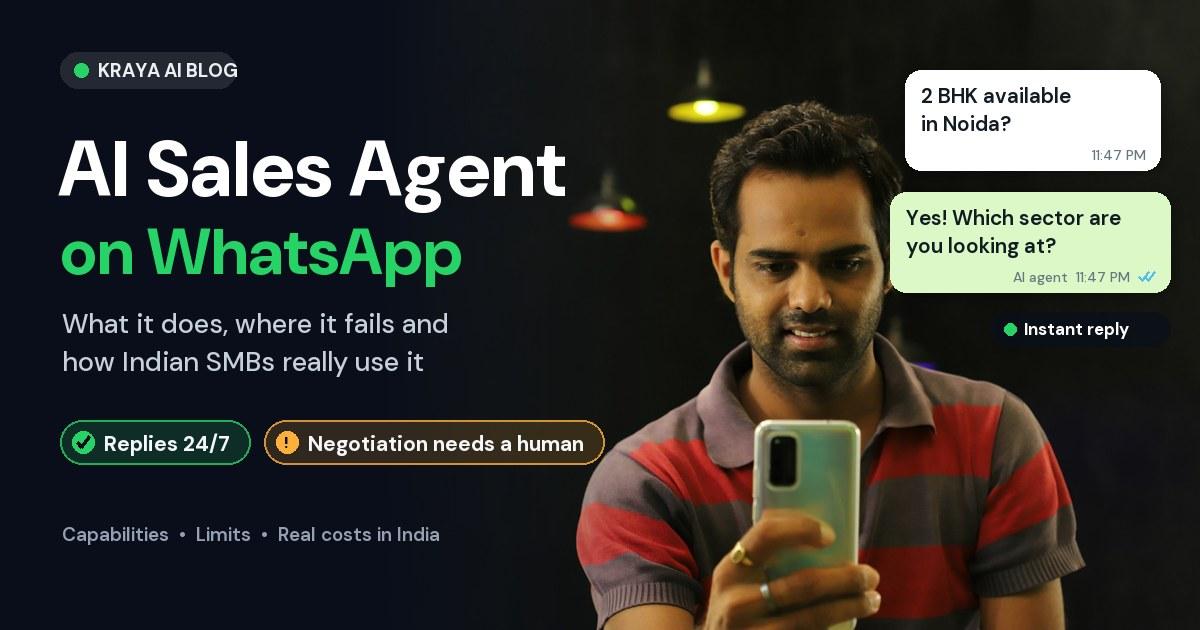
It is 11:47 PM. A buyer who clicked your Meta ad types "2 BHK available in Noida?" on WhatsApp. Your team logged off at 7. By the time someone replies the next morning, the buyer has spoken to two brokers who answered in minutes. An AI sales agent is built for this gap. It answers at 11:47 PM, asks about budget and location, and leaves a summary for your team. Buying more leads does not fix this. If paid leads wait twelve hours for a reply, more ad spend only makes the leak bigger.
This guide explains what an AI sales agent does and where it fails. It also covers what it costs in India after Meta's October 2026 price change, and where a person must stay in charge.
What Is an AI Sales Agent?

An AI sales agent is software that holds sales conversations with leads in everyday language. It answers questions from your approved business information, asks qualifying questions, records the answers in a CRM and passes serious or complex enquiries to a salesperson. Unlike a scripted bot, it understands free-text replies.
A scripted bot says, "Type 1 for the brochure." An AI sales agent can read "budget 80 tak hai, possession next year chahiye" and pick out a budget and a timeline. That flexibility is also the risk. A system that interprets language can misread it.
There are two main types:
Inbound AI sales agents reply to people who contacted you first, through an ad, a form, IndiaMART or WhatsApp. Most Indian SMBs start here.
Outbound AI sales agents, often called AI SDRs, find prospects and send cold emails or calls. They suit B2B software sales more than a clinic or travel agency.
Example: a parent messages a coaching institute at 9 PM. The agent asks the student's class and target exam, shares batch timings and books a counselling call. The counsellor does the selling. For the wider picture, see our guide to AI in sales automation.
How Does an AI Sales Agent Work?
An AI sales agent reads each new message, checks your approved information and replies. It then updates the lead record and decides whether to keep talking, follow up later or pass the chat to a person. What it can do depends on the tools you connect and the permissions you give it.
Receives an enquiry from WhatsApp, a lead form or a marketplace.
Understands the question, including mixed Hindi and English.
Looks up approved information, such as prices or timings, in a knowledge base.
Asks qualifying questions, one at a time.
Records details like budget, location and timeline.
Updates the lead in your CRM or Google Sheet and alerts a salesperson.
Sends approved follow-ups if the lead goes quiet.
Hands complex chats to a person, with a summary.
For an ad-driven business, the path is: Meta Ad → WhatsApp enquiry → AI response → lead qualification → CRM update → human handover → follow-up → sales outcome. Click-to-WhatsApp ads add their own timing rules, covered in our Click to WhatsApp ads follow-up guide.
Speed helps. A 2011 Harvard Business Review study audited 2,241 US companies. Firms that tried to contact a web lead within an hour were nearly seven times as likely to qualify it as firms that tried an hour later. But the study is old and American, and a fast wrong answer is still worse than a slower right one.
What Can an AI Sales Agent Actually Do?

An AI sales agent handles the repetitive middle of a sales chat: first replies, FAQs, budget and location questions, bookings and approved follow-ups. It can help with lead priority and chat summaries. It should not make promises, negotiate or handle complaints alone.
Kraya AI uses an editorial framework called the AI Sales Agent Responsibility Matrix to decide which tasks go to the AI. It is a planning tool, not a scientific study. Each task falls into one of three columns.
Sales task | AI can handle | AI can assist | Human required |
|---|---|---|---|
First reply to a new enquiry | ✓ | ||
FAQs from approved content | ✓ | ||
Budget, location and timeline questions | ✓ | ||
Appointment or site-visit booking | ✓ | ||
Follow-up reminders within set rules | ✓ | ||
Recovering inactive leads | ✓ | ||
Lead prioritisation | ✓ Suggests, team confirms | ||
Chat summaries for the sales team | ✓ Drafts, rep reviews | ||
Custom quotations | ✓ Collects needs | ✓ Approves price | |
Discounts and negotiation | ✓ | ||
Sensitive medical or money questions | ✓ | ||
Complaints and refunds | ✓ | ||
High-value purchase decisions | ✓ Shares facts | ✓ Advises | |
Final commitments (booking amount, contract) | ✓ |
The rule is simple. If a wrong answer could cost money, trust or legal trouble, a person owns that step. For more on qualifying leads, read how AI qualifies leads on WhatsApp.
How Is an AI Sales Agent Different From a Chatbot or CRM?
An AI sales agent holds flexible sales conversations. A rule-based chatbot follows fixed menus. A CRM stores lead records, and a human salesperson negotiates and makes judgement calls. Many products now mix these roles, so judge a tool by what it does, not what it is called.
Capability | Rule-based chatbot | AI sales agent | Traditional CRM | Human sales rep |
|---|---|---|---|---|
Understands context | Keywords only | Yes, but can misread | No | Yes |
Flexible conversation | Fixed flows | Free text | No | Yes |
Lead qualification | Fixed questions | Adaptive questions | Stores results | Deep but slow |
Follow-ups | Scheduled blasts | Context-aware, within rules | Reminders | Inconsistent at volume |
Lead records | Minimal | Updates if connected | Core job | Manual entry |
Negotiation | No | Should not | No | Yes |
Complex decisions | No | Limited | No | Yes |
Human judgement | No | No | No | Yes |
Setup needs | Low | Knowledge base, CRM, calendar | Lead sources | Training |
Many CRMs now have AI features too. The useful test is simple: does the tool understand free text, update your lead records and stop when a person takes over? We compare bot types in AI vs rule-based WhatsApp chatbots.
Where Do AI Sales Agents Fail?

AI sales agents fail when they answer beyond their approved information, misread what a customer wants, keep messaging people who said no, or never pass hard chats to a person. Most failures come from setup and data, not the AI model alone, so most can be reduced.
The root problem is that AI models can give confident wrong answers. OpenAI's September 2025 research says this happens partly because training rewards guessing over admitting uncertainty. The business pays for the guess. In Moffatt v. Air Canada (2024), a Canadian tribunal held the airline responsible for wrong fare information from its website chatbot.
Failure | Business impact | How to prevent it | When a human steps in |
|---|---|---|---|
Says a flat is available after stock changed | Lost trust | Daily stock sync; "our advisor will confirm" | Any availability question |
Quotes an old price | Margin loss | One dated price sheet | Any price not on the sheet |
Treats "just checking" as a hot lead | Wasted calls | Clear scoring rules | When a rep disputes a tag |
Guesses on vague replies | Wrong next question | Ask one clarifying question | After two unclear replies |
Misreads Hinglish ("thoda kam ho sakta hai?") | Odd or wrong reply | Test 30 real past chats | Untested languages |
Agrees to a discount | Unapproved promise | Rule: never offer discounts | Every discount request |
Mishandles emotional messages | Brand damage | Topic triggers for handover | Grief, health worry, anger |
Scores a good lead as cold | Lost sale | Score on answers, not tone | Before dropping a lead |
CRM sync breaks | Missing leads | Test with 20 dummy leads | When sync errors appear |
Repeats follow-ups | Blocks and reports | Stop on reply or "not interested" | After any opt-out |
No way to reach a person | Customer stuck | "Talk to a person" option | Any request for a human |
Collects data without consent | Legal risk | Opt-in, notice, few fields | Any deletion request |
Three controls prevent most of these: a knowledge base with a date on every price, firm rules on what the agent must never say, and a clear handover point. If some leads still convert better by phone, our AI vs manual lead qualification guide explains when manual wins.
Why Are Indian SMBs Using AI Sales Agents on WhatsApp?
Indian SMBs use AI sales agents on WhatsApp because their customers already message businesses there, and small teams cannot reply at all hours. Meta cites a 2025 Kantar study that found 91% of online adults in India chat with a business every week.
That figure comes from Meta's May 2026 announcement of Business AI, an AI agent built into the WhatsApp Business app for Indian small businesses. Meta said it works in all native Indian languages and lets owners take over complex chats.
Sales teams are also short of time. Salesforce's State of Sales findings for India (March 2026) found Indian sellers spend only 41% of their time actually selling. Only 250 of the 4,050 people surveyed were in India, and not all worked at SMBs, so treat this as a signal, not a rule.
The usual pattern: ad leads arrive in bursts, often at night, and a few salespeople handle hundreds of enquiries. Customers mix English, Hindi and Hinglish, and follow-ups live in Excel. But a manufacturer with ten large accounts may need a better CRM, not an AI agent. Our guide to lead management software for small businesses helps you check.
How Do Indian Businesses Use AI Sales Agents in Different Industries?
Indian businesses use AI sales agents to collect what a salesperson needs before the first call. That means budget and location in real estate, appointment needs in clinics, and course and intake year in education. The examples below are hypothetical, not client case studies.
Industry | Common problem | Example enquiry | What the AI asks or does | Hands over when | Benefit |
|---|---|---|---|---|---|
Real estate | Brokers call every lead, even outside budget | "3 BHK in Wakad, ready to move?" | Budget, possession date, home loan, visit day | Lead wants a site visit or a specific unit | Calls start with needs known |
Clinics | Missed calls while staff are busy | "Laser hair removal ka charge kitna hai? Saturday slot milega?" | Shares published fee and open slots, books visit | Any question on symptoms, medicines or suitability | Front desk stops repeating answers |
Education and study abroad | Counsellors talk to poor-fit students | "MS in Germany ke liye consultation chahiye" | Course, intake year, degree, scores | Profile review, scholarships, service fees | Counselling time goes to good fits |
Travel | Quotes built for people who never reply | "Kerala package for family, December?" | Dates, travellers, hotel type, budget | Custom itinerary and final price | Agents quote only serious requests |
Fitness and services | Slow callbacks and no-shows | "GST registration ke liye kitna lagega?" | Business type, timeline, call time, reminder | Scope, custom fees, any advice | More consultations actually happen |
In clinics the agent handles admin only. It must never diagnose or advise on treatment. For property teams, see our WhatsApp CRM guide for real estate in India.
What Does an AI Sales Agent Conversation Look Like on WhatsApp?
A good AI sales agent conversation on WhatsApp uses short messages, asks one question at a time, never invents availability and ends with a clear handover. The example below is illustrative. It is not a real customer chat or real stock.
Customer: 2 BHK available in Noida?
AI agent: Yes, I can help you check options. Which sector are you looking at?
Customer: Sector 150
AI agent: Got it. What budget range are you considering?
Customer: Around ₹80 lakh
AI agent: Thanks. Do you need ready-to-move, or is under-construction fine?
Customer: Ready to move chahiye, 6 months mein
AI agent: Understood. Will you take a home loan?
Customer: Haan, pre-approval ho gaya hai
AI agent: That helps. Our property advisor will confirm which ready-to-move 2 BHKs in Sector 150 fit your range. Is a call tomorrow at 11 AM or 4 PM better?
Customer: 4 PM
AI agent: Done. Our advisor will call you at 4 PM tomorrow. If you want to talk tonight, type "call me".
The agent never said a flat was available. It never offered a discount or pushed for a visit. The advisor's call starts with budget, location, timeline and loan status known. For more question ideas, see how to qualify leads on WhatsApp.
How Much Does an AI Sales Agent Cost in India?
An AI sales agent in India has two separate costs. The first is the software subscription, about ₹2,700 to ₹17,000 a month on public price lists. The second is Meta's charge for each WhatsApp message. Setup fees, extra users and AI credits can add more, and your total depends on lead volume and features.
Prices from public pricing pages, checked on 26 November 2026, before GST:
Vendor | Published price | Note |
|---|---|---|
Interakt | ₹2,799 or ₹3,799 a month | AI agents need the Growth or Advanced plan |
Wati | ₹2,699 to ₹16,799 a month, billed quarterly | AI limits rise by plan |
Gallabox | ₹6,999 or ₹16,999 a month, billed quarterly | WhatsApp AI agents start at ₹6,999 |
Kraya AI | ₹9,999 to ₹49,999 one-time setup, then ₹2,999 a month | Main seat includes 7,500 AI credits |
Meta bills message charges separately. Meta's WhatsApp pricing for India from 1 October 2026:
Message type (India) | Meta charge per delivered message |
|---|---|
Marketing template | ₹0.8631 |
Utility template | ₹0.115 |
Authentication template | ₹0.115 |
Service reply within 24 hours of the customer's last message | ₹0.115 after 1,000 free per number each month |
Meta Business Agent reply | About ₹3.7–₹4.7 ($0.04–$0.05), billed at $2 per million tokens |
Two points most cost guides miss. Service replies were free until 30 September 2026, so older guides understate your bill. And Meta's own Business Agent is billed per token, so 4,000 replies a month could cost about ₹15,000–₹19,000 in Meta charges alone. Messages in a free entry point window, such as one opened by a Click-to-WhatsApp ad, are free, except Meta Business Agent replies. Rupee figures use the FBIL rate of about ₹93.35 per US dollar on 19 November 2026. Our WhatsApp API for sales guide covers setup costs.
Is an AI Sales Agent Worth the Investment for Small Businesses?
An AI sales agent is worth it when the extra profit from better lead handling beats the full system cost. Use contribution margin, not revenue, because revenue ignores what each sale costs you to deliver. The example below is hypothetical, not a promised result.
Item (illustrative) | Value |
|---|---|
Monthly leads | 500 |
Conversion rate now | 2% (10 customers) |
Improved conversion rate | 3% (15 customers) |
Extra customers | 5 |
Average revenue per customer | ₹10,000 |
Extra monthly revenue | ₹50,000 |
AI system cost | ₹8,000 a month |
Extra revenue minus software cost | ₹42,000 before other costs |
That ₹42,000 is not profit. Use these formulas:
Incremental contribution = Extra customers × Contribution per customer
Net incremental benefit = Incremental contribution − Total extra system costs
ROI = Net incremental benefit ÷ Total extra system costs × 100
Example at a 40% contribution margin: each customer adds ₹4,000, so five customers add ₹20,000. System cost is ₹8,000 plus about ₹860 in Meta charges, or ₹8,860. That Meta figure assumes 3,000 paid AI replies at ₹0.115 (after 1,000 free) and 600 marketing follow-ups at ₹0.8631. Net benefit is about ₹11,140. ROI is about 126%.
Break-even: divide system cost by contribution per customer. ₹8,860 ÷ ₹4,000 = 2.2, so you need about three extra customers a month, or conversion rising from 2.0% to about 2.6%. At a 15% margin, you would need six. Figures exclude GST.
How Can a Small Business Set Up an AI Sales Agent on WhatsApp?

A small business can run a small AI sales agent pilot in about seven working days if its WhatsApp Business Platform account is ready. Meta verification, template approval and integrations can take longer, so start them first.
Day 1: Audit current lead handling. Note reply times, lead sources and where leads go cold.
Day 2: Define qualifying questions. Pick four or five, such as budget, location and timeline.
Day 3: Prepare the knowledge base. Add dated prices, FAQs and things the agent must never say.
Day 4: Connect WhatsApp and your CRM. Submit follow-up templates; see why WhatsApp templates get rejected.
Day 5: Set follow-up rules and handover. Decide when messages stop and who gets alerted.
Day 6: Test hard and multilingual chats. Use real past chats, including Hinglish ones.
Day 7: Launch a small pilot. Start with one lead source and read every chat daily.
Track these metrics:
First response time and qualification completion rate
Qualified lead rate
Appointment booking and show-up rates
Human escalation rate and wrong-answer rate
Lead-to-customer conversion and cost per qualified lead
Opt-out and complaint rates
Speed alone does not decide sales success. A faster reply with more complaints is a failed pilot.
What Should Businesses Check Before Choosing an AI Sales Agent?
Before choosing an AI sales agent, check that it uses the official WhatsApp Business Platform and answers only from your approved content. It should also hand chats to people cleanly and update your CRM. Then check costs, consent handling and how you will catch mistakes.
Check | Must-have? | Ask in the demo |
|---|---|---|
WhatsApp integration | Yes | Is it on the official WhatsApp Business Platform? |
Answer quality | Yes | Answer three of our real past chats |
Knowledge base | Yes | How fast do price changes apply? |
Custom questions | Yes | Can we set our own criteria? |
Human handover | Yes | Does the AI pause when my rep replies? |
Follow-up controls | Yes | Does it stop on reply or opt-out? |
Data privacy | Yes | Who can see and export chats? |
Consent and opt-out | Yes | How are opt-outs recorded? |
Clear pricing | Yes | Software, AI credits and Meta fees, shown separately? |
Error monitoring | Yes | How do we spot wrong answers and failed messages? |
CRM integration | Depends | Two-way sync with our CRM or Sheets? |
Hindi and Hinglish | Depends | Test them live |
Analytics | Depends | Qualified-lead rate by source? |
Setup support | Depends | Who builds the first setup? |
Failed messages matter too. See why WhatsApp messages are not delivering.
Is It Safe to Use AI Sales Agents on WhatsApp in India?
AI sales agents on WhatsApp are safe to use in India when the business gets opt-in, follows WhatsApp's rules and protects personal data under the DPDP rules. A person must stay responsible for what the agent says. No tool makes a business compliant on its own.
Opt-in: Meta's opt-in rules require permission before you message people. The opt-in must name your business, and opt-outs must be honoured.
24-hour window: free-form replies are allowed only within 24 hours of the customer's last message. After that, only approved templates can be sent.
Business AI only: WhatsApp banned general-purpose AI assistants from its business platform from 15 January 2026, TechCrunch reported. Agents that serve your own customers are a different use, but check the current terms.
Data protection: India's DPDP Rules were notified on 14 November 2025 with an 18-month rollout. Businesses must give a clear consent notice. Penalties go up to ₹250 crore for weak security. MeitY proposed faster deadlines in early 2026, so check the current dates.
Data and access: collect only the fields you need and limit who can export chats.
Human review: read a sample of chats every week. As the Air Canada case shows, you own what your agent says.
Unofficial WhatsApp tools add account risk. Our guide to WhatsApp automation ban risk explains why.
How Does Kraya AI Help Indian SMBs Manage Sales on WhatsApp?

Kraya AI is a WhatsApp-first CRM for Indian SMBs. It combines AI lead qualification, follow-up sequences and lead management. It is built to support a sales team, not replace it. The AI handles first replies and routine questions, and people handle judgement.
According to Kraya's product documentation, it works in three areas:
AI lead qualification. The AI replies using your knowledge base and tags each lead as high, medium or low intent. It writes a summary into the lead's notes and can book calls on your calendar.
Follow-up sequences. You set the steps and timing for WhatsApp messages, templates, emails and team reminders. These run on your rules, separate from the AI chat.
Lead management. Leads from Meta Lead Ads, IndiaMART, JustDial and website forms land in one pipeline. A Co-Pilot view flags leads that need attention.
On official WhatsApp Business API numbers, the AI pauses when a team member replies, so handover stays clean. Results still depend on your offer, your lead quality and your team's follow-through. To see how sequences are built, read our automated follow-up sequences guide.
Related Blogs
More Kraya AI guides on lead handling and WhatsApp sales:
Conclusion
An AI sales agent suits Indian businesses that get steady WhatsApp or ad leads, lose some to slow replies and sell through a call, visit or appointment. Real estate, clinics, education, travel and service firms fit well. A business with a few large accounts, or one where every enquiry needs expert advice, will gain less.
The agent works best inside a clear sales process. That means firm qualifying rules, an accurate knowledge base, a person who owns every promise and a weekly review of the AI's chats. Set up this way, your team spends its time on the conversations that need a human.